Understanding BIM LOD, Levels, and LOI: Navigating the Depth of Building Information Modeling
Understanding BIM LOD, Levels, and LOI: Navigating the Depth of Building Information Modeling
BIMCAD Journalist 11/03/2026
Building Information Modeling (BIM) is redefining how architects, engineers, and contractors collaborate in the digital era. Instead of relying on traditional 2D drawings, BIM creates a data-rich 3D model that accurately represents the physical and functional characteristics of a building.
To fully leverage this capability, project stakeholders must understand two core concepts: LOD (Level of Detail) and LOI (Level of Information). Together, these concepts define both the geometric depth and the information content of the model at each project stage, ensuring that every decision is based on accurate and reliable data.
BIM & CDE – The Foundation of Digital Collaboration in Construction
BIM and CDE Concepts
BIM (Building Information Modeling): A construction process that uses a 3D model integrated with technical data. It enables stakeholders to collaborate on a single digital platform throughout the entire lifecycle of a project, from design to operation.
CDE (Common Data Environment): A shared data environment for the entire BIM project. Within this environment, stakeholders can update, manage, and share information in real time. CDE helps synchronize data, reduce errors, and improve coordination efficiency.
Key Benefits
Reduce design time by 30–50% through real-time updates and coordination.
Minimize on-site conflicts by enabling virtual simulation before construction.
Optimize lifecycle costs by managing digital assets from the early design stage.
Enhance multidisciplinary collaboration through a single CDE platform.
Enable faster and more accurate decision-making based on synchronized BIM data that is easy to access and track.
LOD – The Level of Geometric Detail in BIM Models
LOD (Level of Detail) represents the level of geometric detail of components within a BIM model. It indicates how fully an object is represented in terms of its size, shape, location, and relationships with other elements. LOD is typically classified on a scale from 100 to 500, corresponding to project stages ranging from concept design to as-built completion.
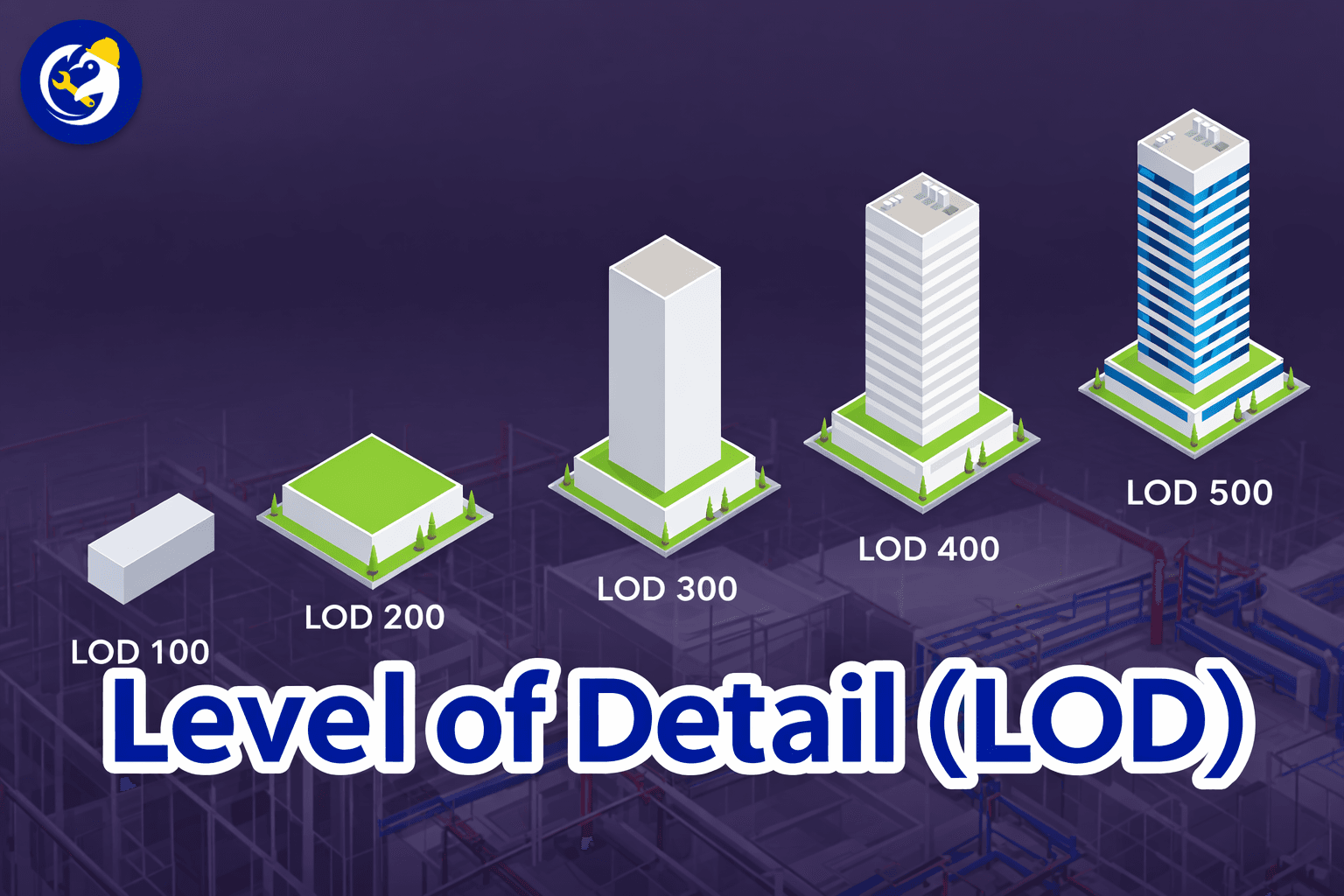
Key LOD Milestones: American Institute of Architects standardized the LOD framework from 100 → 500, defining how realistic and reliable the model should be at each stage—from simple conceptual massing to fully verified as-built conditions.
Minh họa trực quan các mức LOD
LOD 100 – Conceptual At this level, the model represents only the overall massing, with approximate size, shape, and location. It is primarily used to evaluate early design ideas, support concept studies, and conduct feasibility analysis.
LOD 200 – Approximate / Schematic The model begins to show relatively accurate geometry, approximate locations of elements, and estimated quantities. This level helps visualize spatial layout more clearly and supports preliminary design decision-making.
LOD 300 – Detailed / Design Development At this stage, the model includes accurate dimensions, shapes, and locations of building components. The data is detailed enough to produce technical design documentation, construction drawings, and support multidisciplinary coordination.
LOD 400 – Fabrication / Construction The model incorporates detailed information about materials, real products, fabricated components, and construction sequencing. This level supports off-site manufacturing (prefabrication) and precise on-site construction.
LOD 500 – As-Built This represents the final as-built model, reflecting the actual conditions of the building after construction is completed. The information is field-verified and used directly for operations, maintenance, and asset management, often referred to as Facility Management (FM).
LOI – The Level of Non-Geometric Information
LOI (Level of Information) represents the level of non-geometric data associated with BIM objects. This includes information such as material names, manufacturers, performance data, costs, technical specifications, installation guidelines, and maintenance information. LOI is also typically classified from 100 to 500, where higher levels indicate more complete and verified data.
LOI 100 – Basic: At this level, the model contains basic identification information for elements, such as the object name, material type, and component category. These attributes serve as foundational data used to distinguish and classify components within the BIM model.
LOI 200 – Descriptive: Additional descriptive information is introduced, including manufacturer, product codes, basic technical specifications, and warranty periods. These data support equipment and component selection during the design and procurement phases.
LOI 300 – Technical: At this stage, the model contains more precise technical data such as operational performance, technical standards, installation requirements, and inspection criteria. This information becomes a critical reference during construction and commissioning.
LOI 400 – Quantitative: This level includes detailed quantities, exact dimensions, cost information, measurement units, and data for quantity take-off and cost estimation. It supports construction planning and 4D/5D BIM processes.
LOI 500 – Verified: This level contains actual, verified data after construction is completed, validated through testing, inspection, and commissioning. It may include operation history, maintenance records, and integration with Facility Management (FM) systems, enabling accurate and efficient asset management and building operations.
Conclusion
In the journey of digital transformation in the construction industry, standardizing information through BIM and managing data through a CDE platform is no longer optional—it has become a critical prerequisite for improving efficiency throughout the entire building lifecycle. When LOD and LOI levels are properly defined and implemented, organizations can not only maintain better control over design and construction processes, but also establish a solid foundation for operations and digital asset management.
If you are experiencing challenges in implementing BIM or optimizing workflows on a CDE platform, BIMCAD Vietnam is ready to support you. We offer completely free consultation to help you resolve implementation issues and develop a practical and effective digital transformation strategy tailored to your construction business.
LOD is an important concept in BIM design that defines the level of detail and information required for a BIM model at different stages of a construction project.
3 months ago
Quality & Information Security
are at the core of our priorities.
Contact
Email:sales@tgl-sol.com
Hotline:(+84) 377 359 728
Ho Chi Minh Office:42/1 Ung Van Khiem Street, Ward 25, Binh Thanh District, Ho Chi Minh
Da Nang Office:01 Tran Van Ky Street, Hoa Khanh Nam Ward, Lien Chieu District, Da Nang
Headquarter:3F Tojikyo Building, 16-2 Kodenmacho, Nihonbashi, Chuo-ku, Tokyo, Japan