Structural steel sections are an indispensable material in today’s construction and industrial sectors, thanks to their high strength, flexibility, and exceptional load-bearing capacity. So, what exactly are structural steel sections? How are they manufactured, and which types are the most commonly used? Let’s explore these questions with BIMCAD Vietnam in the article below.
Structural steel sections come in a variety of shapes, ranging from familiar I, H, and U profiles to more complex forms, all designed to meet diverse construction and industrial requirements.
To produce structural steel sections with the diverse shapes and sizes we see today, steel must go through a complex, multi-stage manufacturing process. Below is a summarized overview of how structural steel sections are produced:
The steel production process begins with refining raw iron ore. The ore is fed into a blast furnace, where it is melted at high temperatures to separate iron from impurities, forming pig iron. This pig iron is then transferred to a steelmaking furnace, where impurities are removed and alloying elements are added to produce molten steel. Finally, the molten steel is cast into steel billets, which serve as the raw material for manufacturing a wide range of steel products.
After casting into billets, the steel enters the forming stage. The billets are passed through hot rolling mills, where high temperatures and pressure gradually elongate and shape them into sections with desired sizes and profiles. To achieve higher dimensional accuracy and better surface quality, the steel may undergo cold rolling. Finally, for more complex products, cold processing methods such as bending, cutting, and drilling are applied.
To ensure high-quality final products, structural steel sections undergo strict inspection processes. Each steel member is carefully checked for dimensions, shape, chemical composition, and mechanical properties. Once standards are met, the steel may be galvanized or painted to enhance corrosion resistance and improve aesthetics, meeting diverse customer requirements.
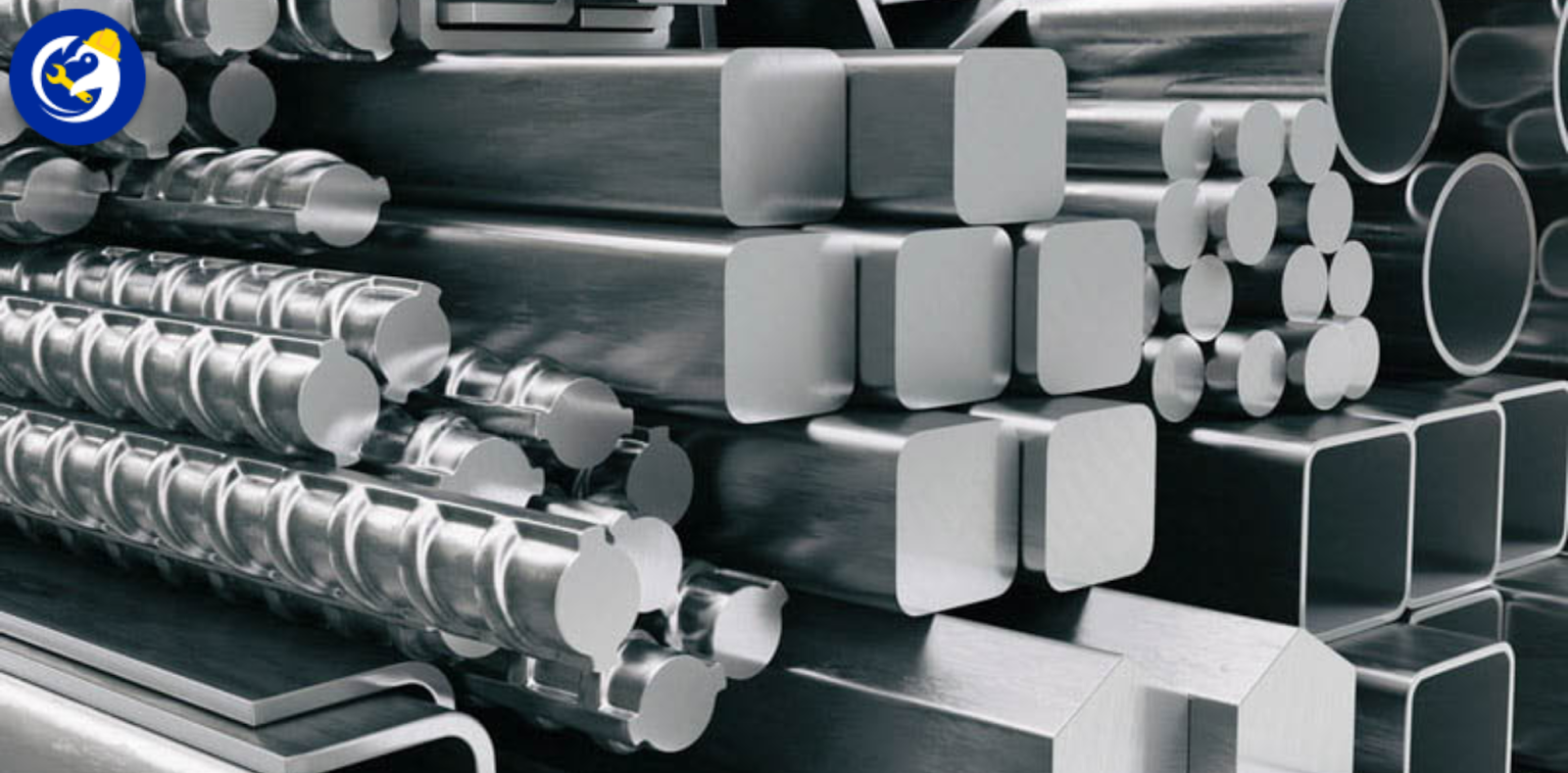
Structural steel sections not only come in a wide variety of shapes and sizes but also offer outstanding advantages. With excellent load-bearing capacity, lightweight properties, and high flexibility, they have become an indispensable material in construction. Thanks to their diverse designs, structural steel sections can meet all technical requirements of a project, from simple components to complex structural systems. Additionally, galvanization helps protect the steel from environmental impacts, ensuring durability and long-term sustainability of the structure.
I-beam steel has a shape similar to the letter “I”, with a thick web in the middle and two thinner flanges on both sides. Thanks to this structure, I-beams offer excellent resistance to bending and compression while maintaining a relatively light weight. Therefore, they are widely used in construction such as bridge girders, main beams in factories, door frames, and many other applications.
H-beam steel is one of the most common types of structural steel sections, widely used in construction due to its superior load-bearing capacity and high stability. With a symmetrical structure, H-beams distribute forces evenly, minimizing deformation risks and ensuring structural safety.
U-channel steel has a cross-section shaped like the letter “U”, known for its precise edges and angles. This feature makes it suitable for manufacturing agricultural tools, transportation vehicles, and repairing industrial equipment. It also provides excellent resistance to torsion and lateral loads.
C-channel steel, also known as a C-section, is one of the most common and versatile types of structural steel. With its characteristic C shape, it offers good resistance to bending and torsion while being easy to connect with other materials.
V-shaped steel has a form similar to the letter “V”, with two equal sides forming a sharp angle. This type is commonly used in structures that require high rigidity and the ability to withstand concentrated loads.
L-angle steel has a shape similar to the letter “L”, with two unequal sides. It is commonly used to form corner joints and to connect structural components within a framework.
| Type of Steel Section | Advantages | Disadvantages |
|---|---|---|
| H-Beam Steel | - High strength and long service life compared to rectangular or square sections.- Easy to use and widely applied in structural design.- Ensures optimal structural performance.- Suitable for connections with main and secondary steel members. | - Inefficient load resistance in the XX direction due to lower structural capacity compared to the YY direction.- Poor torsional resistance due to its open-section design. |
| U/C Channel Steel | - Can replace I-beams when bending resistance is not critical.- Provides a stable structure with high pressure resistance, especially in beams and purlin systems.- Can be combined to form a built-up I-section, expanding usability.- Good connectivity with other steel members and flat surfaces such as concrete and brick. | - Unstable under load without top bracing due to asymmetry along the YY axis.- Not suitable for heavy load applications. |
| V-Shaped Steel | - High connectivity at joints; good shear resistance at bolts and welds.- Suitable as bracing members with excellent axial bending resistance.- Can be adjusted to form a built-up T-section, increasing flexibility in applications. | - Asymmetrical geometry along both XX and YY axes, limiting its use in some designs.- Less commonly used compared to other materials due to its unique structure. |
| L-Angle Steel | - High strength and stiffness.- Excellent resistance to pressure, heavy loads, and impact.- Resistant to environmental factors such as humidity, weather, and chemicals. | - Limited ability to withstand strong, high-intensity vibrations.- May deform under extreme impact conditions. |
Structural steel sections, with their diversity in shapes, sizes, and mechanical properties, have become one of the indispensable construction materials in the modern era. From simple residential projects to complex industrial structures, they play a crucial role in creating strong, durable, and safe constructions.
Structural steel is not just a building material—it is also an optimal solution for modern construction projects. With its outstanding advantages and wide range of applications, it continues to strengthen its position in the construction industry.
Are you facing challenges in implementing BIM, Revit, CDE, or any technological and technical aspects related to BIM for your project?
Don’t worry — BIMCAD Vietnam is always ready to support you!