During the execution of a construction project, issues are inevitable. From drawing errors and interdisciplinary clashes to on-site problems, all of these need to be properly recorded and resolved in a timely manner.
However, in many projects in Vietnam, issue management is still handled in an ad-hoc manner—through Zalo messages, phone calls, or scattered notes. This often leads to lost information, delayed resolution, and a lack of clear accountability.
In this context, adopting a CDE (Common Data Environment) becomes a critical factor in ensuring project progress and overall efficiency.

Issue Management is the process of capturing, tracking, and resolving issues throughout the entire project lifecycle. Each issue is not just a standalone problem, but a task that requires complete and structured management.
A standard issue typically includes:
When managed properly, issues become an integral part of the project workflow—rather than scattered, informal exchanges.
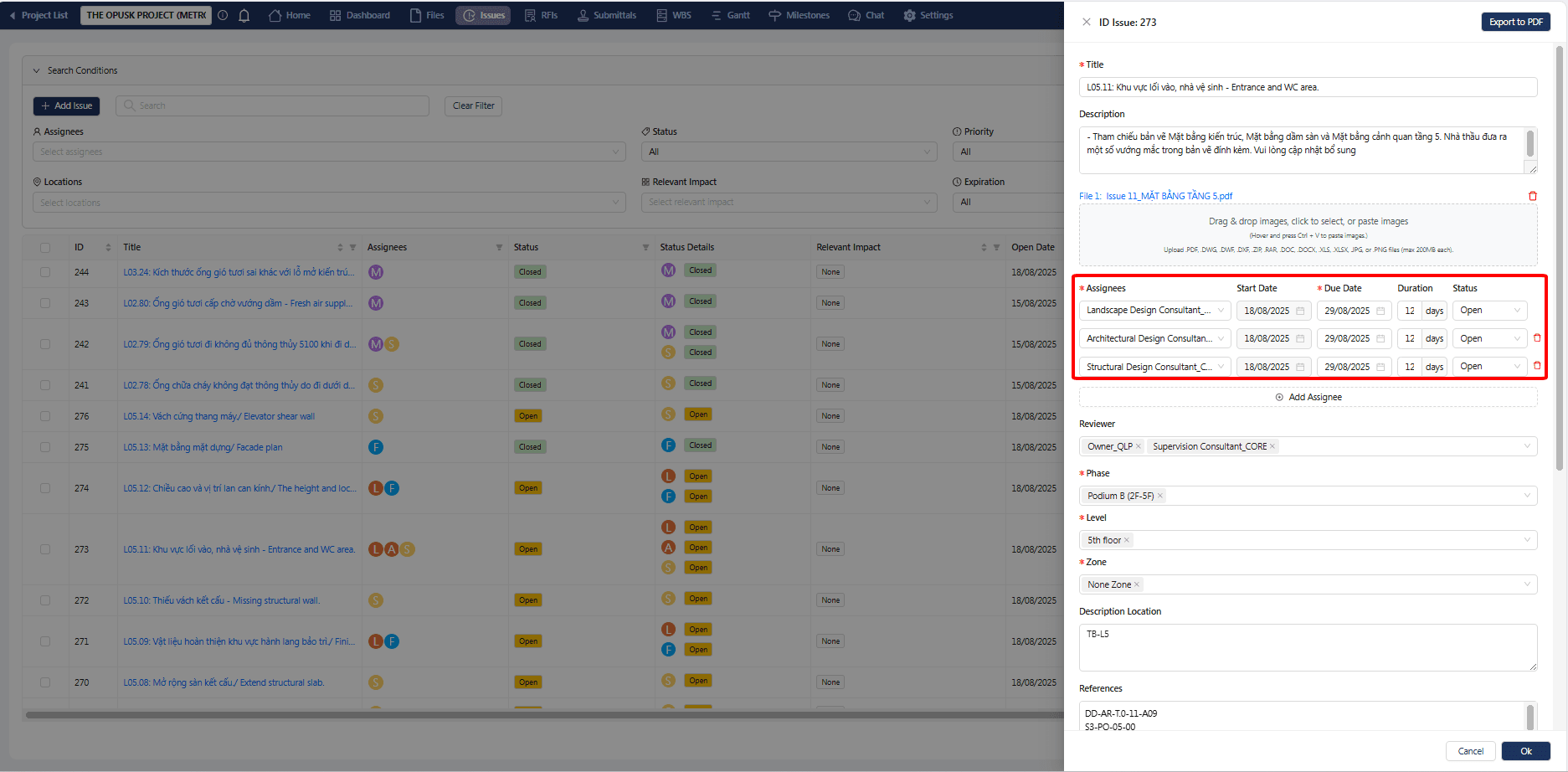
Integrating Issue Management into a CDE (Common Data Environment) provides a structured and synchronized way to address these challenges. Issues are no longer scattered conversations, but become an integral part of the overall project data management system.

In a CDE environment, issues are managed through a clear, structured, and centralized workflow
1. Create
2. Assign
3. Track
4. Resolve
5. Close
All issues are stored in a single, centralized platform, eliminating the risk of lost or scattered information. This ensures that every stakeholder can access and work on the same set of data.
Each issue is assigned to a specific owner with a defined deadline, making responsibilities transparent and preventing situations where tasks are overlooked or left unresolved.
Communication happens directly within the system, reducing reliance on emails and external tools. This streamlines discussions and significantly speeds up issue resolution.
Site teams can create issues directly from the field, often with attached photos or model references, allowing design teams to review and respond almost instantly. This bridges the gap between office and on-site workflows.
Issues are identified, tracked, and resolved at an early stage, preventing errors from propagating into later construction phases. This minimizes costly rework and improves overall project quality.
More importantly, CDE connects Issue Management with the entire project data ecosystem.

Learn more: Comparison Traditional Workflow and CDE Based Workflow
In this context, VinaCDE provides an issue management solution tailored to the realities of project implementation in Vietnam. The system enables teams to capture and track issues in a way that is both simple and comprehensive.
Key capabilities include:
As a result, organizations can gain better control over arising issues, reduce risks, and minimize impacts on project timelines.

Learn more : VinaCDE – A Comprehensive Construction Project Management Platform
In construction projects, issues themselves are not the problem—how they are managed is what truly determines success.
A CDE-based approach fundamentally transforms Issue Management by bringing structure, transparency, and control into the process. It enables faster collaboration across teams, reduces errors and rework, and accelerates overall project delivery. As BIM adoption continues to grow, integrating Issue Management within a CDE is no longer optional—it is becoming a standard requirement for delivering efficient and successful projects.
Are you facing challenges in implementing BIM, Autodesk Revit, CDE, or any other BIM-related technologies and technical aspects for your project?
Don’t worry— BIMCAD Vietnam is always ready to support and accompany you!